


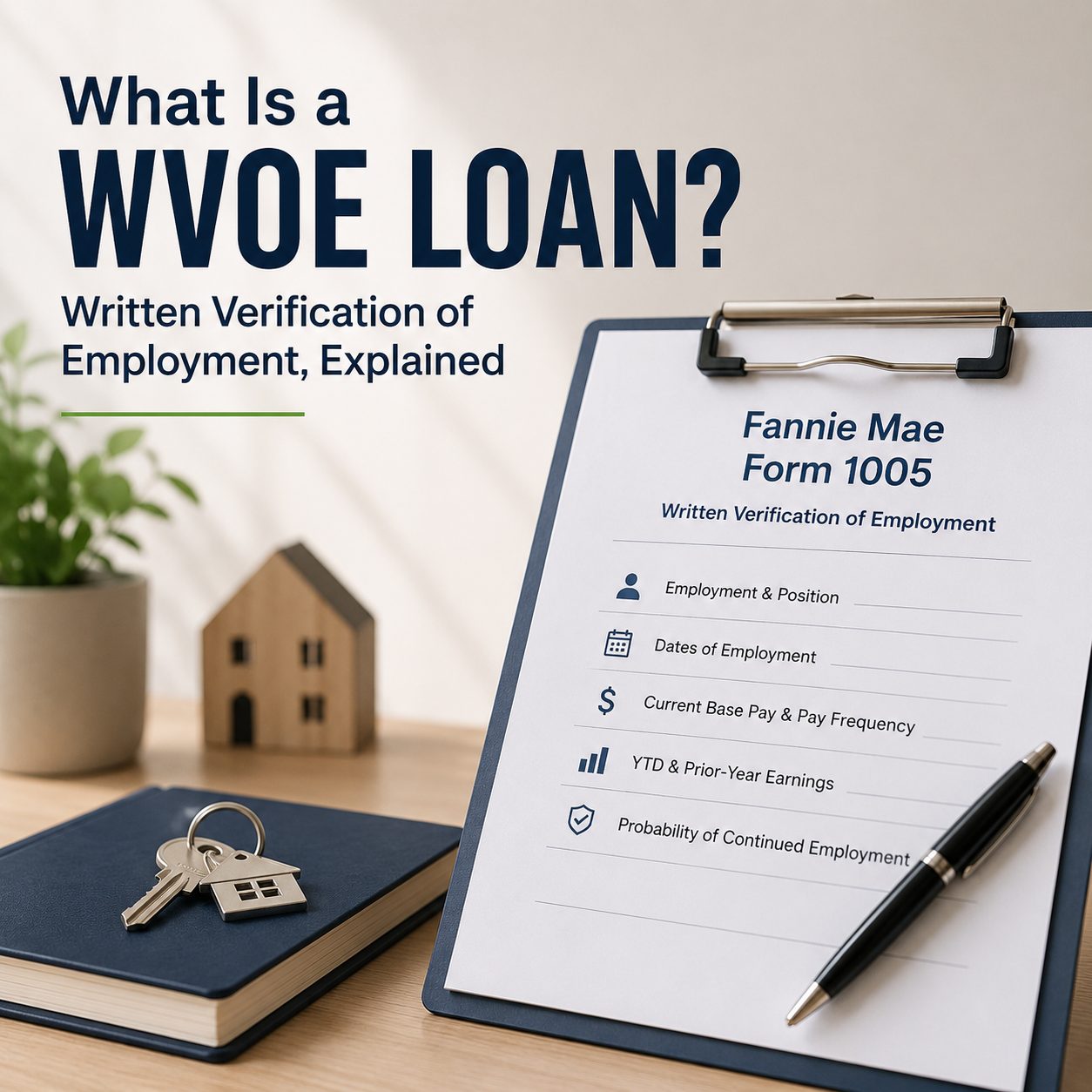
What Is a WVOE Loan? Written Verification of Employment, Explained
If you’ve come across the term “WVOE” while researching mortgages, you’re not alone — it’s one of the most searched-for and most misunderstood pieces of the home-loan process. This guide explains what a Written Verification of Employment is, how the Form 1005 works, how WVOE-only mortgage programs fit self-employed and non-traditional borrowers, and where to go next if your income is hard to document the conventional way.
Talk to a Loan Officer About Your Options (English / 한국어)
What Is a WVOE?
WVOE stands for Written Verification of Employment. It’s a form a mortgage lender sends directly to your employer to confirm your job, your dates of employment, and your income in writing — independent of the pay stubs or W-2s you provide. Lenders use it to verify that the income on your application is real and stable before they approve a home loan. In everyday mortgage conversation, a “WVOE loan” or “WVOE-only mortgage” refers to a program where a completed Written Verification of Employment stands in for traditional income documents like pay stubs and tax returns — an option some lenders offer for borrowers whose income is harder to document the conventional way.
WVOE vs. VVOE vs. Traditional VOE
There are three ways lenders verify employment, and the acronyms get confused often:
- WVOE (Written Verification of Employment) — a written form completed and signed by your employer, capturing your position, dates, and income. This is the “paper trail” version.
- VVOE (Verbal Verification of Employment) — a quick phone call the lender makes to your employer, usually within a few days of closing, just to confirm you’re still employed. Most conventional loans use a VVOE at the end in addition to your regular pay stubs and W-2s.
- Traditional VOE — the standard income-documentation path: pay stubs, W-2s, and tax returns, with a verbal check before closing.
A WVOE-only program leans on the written form as the primary income proof, rather than requiring the full stack of pay stubs and tax returns.
The WVOE Form (Fannie Mae Form 1005 / Freddie Mac Form 90)
The industry-standard written verification form is Fannie Mae Form 1005 (Freddie Mac’s equivalent is Form 90). Your lender — not you — sends it to your employer’s HR or payroll department. The form asks the employer to confirm:
- Your job title and employment dates (start date, and whether you’re still employed)
- Your current base pay and pay frequency (hourly, salary, commission)
- Year-to-date and prior-year earnings, including overtime, bonuses, or commission
- The probability of continued employment
You generally don’t fill out the WVOE yourself — you authorize the lender to request it. If you’re gathering documents ahead of an application, the most helpful thing you can do is make sure your employer’s HR/payroll contact is current and responsive.
What Is a WVOE-Only Mortgage Program?
A WVOE-only mortgage is a type of non-QM (non-qualified mortgage) program where a completed Written Verification of Employment replaces the usual pay-stub-and-tax-return documentation. Because underwriting relies on the employer’s written confirmation of income rather than a two-year paper trail, this can be a fit for borrowers whose income is real and stable but awkward to document the traditional way. Prime Home Loans offers a WVOE mortgage program for exactly these situations. Terms, rates, and down-payment requirements differ from conventional, FHA, or VA loans and depend on your profile. Whether a WVOE-based option makes sense for you depends on your full financial picture — a licensed loan officer can walk you through what documentation your situation actually calls for.
Who a WVOE Loan Is For
Written-verification programs tend to come up for:
- Self-employed and 1099 borrowers whose tax returns understate their real cash flow after write-offs
- Commission or bonus-heavy earners whose base salary doesn’t reflect their true income
- Gig and contract workers with steady employers but non-traditional pay
- Newcomers to the U.S. building a documentation history — see our guide on buying a house in the U.S. on a visa
If that sounds like you, the right next step isn’t to pick a program off a page — it’s to have a loan officer review your income and documents and tell you which loan types you’d actually qualify for. You may also want to compare it against standard options like conventional loans and FHA loans.
Talk to a Loan Officer About Your Options
Prime Home Loans offers a WVOE mortgage program — see program details and get started on our Written Verification of Employment program page. Our team can review your situation and explain how the program works — including how employment and income get verified — in English or 한국어. Every file is different, and the fastest way to know what you’d qualify for is a quick, no-obligation conversation with a licensed loan officer. (NMLS #98975.)
See WVOE Program Details & Get Started (English / 한국어)
Frequently Asked Questions
What does WVOE stand for?
WVOE stands for Written Verification of Employment. It is a form a mortgage lender sends directly to your employer to confirm your job title, employment dates, and income in writing, independent of the pay stubs and W-2s you provide.
What is a WVOE in a mortgage?
In a mortgage, a WVOE (Written Verification of Employment) is a document your lender uses to confirm your income and employment directly with your employer. A WVOE-only mortgage is a program where that written form serves as the primary income documentation instead of pay stubs and tax returns.
What is the difference between WVOE and VVOE?
A WVOE (Written Verification of Employment) is a written form completed and signed by your employer confirming your income and job details. A VVOE (Verbal Verification of Employment) is a quick phone call the lender makes to your employer, usually just before closing, to confirm you are still employed.
What form is used for a written verification of employment?
The industry-standard form is Fannie Mae Form 1005 (Freddie Mac uses Form 90). The lender sends it to your employer’s HR or payroll department to confirm your position, employment dates, current pay, and year-to-date and prior-year earnings.
Who fills out a WVOE form?
Your employer completes the WVOE form, not you. You authorize the lender to request it, and the lender sends it directly to your employer’s HR or payroll department to be filled out and returned.
Who is a WVOE-only mortgage for?
WVOE-only programs are non-QM loans that can fit self-employed and 1099 borrowers, commission or bonus-heavy earners, gig and contract workers, and others whose income is stable but hard to document with traditional pay stubs and tax returns. A loan officer can confirm whether it fits your situation.
Final Thoughts
A WVOE is simply a written way for a lender to confirm your income straight from your employer — and for some borrowers, a WVOE-based program can open a path to homeownership that traditional documentation makes difficult. Whether you’re self-employed, commission-based, a gig worker, or new to the U.S., the smartest move is to have a licensed loan officer review your actual situation and explain which loan types fit.
Ready to Explore Your Options?
Our team at Prime Home Loans, Inc. helps clients across Texas, Georgia, Tennessee, and beyond navigate the U.S. mortgage process with clarity and care — including borrowers with non-traditional income.
Explore our loan programs, learn about special financing options, or contact us to get personalized advice today.


